
I’ve been diagnosed with an ‘ugly’ prostate cancer. It’s a simple, hard and unavoidable fact, and it is nothing to try to hide or escape from. So, there is nothing else to do than to take out the somewhat cynical perspective on life I’ve inherited from my father. I will therefore not delve into a sad story full of pitying and negativity. If I cannot change something, I can just as well observe what happens and learn from it. And then I can share my thoughts about everything that happens around me, as I will do in this post. Here I will describe my experiences as a combined patient and HMI researcher from the first of a sequence of in total twenty-nine days of two minute radiation treatments. And there will of course be one “conclusion” of my experiences at the end of the post (although, it might not be what you expected).
The treatment of prostate cancer has taken huge steps forward over the years, and I’m not as scared as I probably should have been fifteen or twenty years ago. “Cancer” is still a scary word, and we don’t talk about it in the same way as we talk about a flu or maybe more accurately about having a pneumonia. But I will try to look away from the scariness, and go into “observation mode”. And here is what I have observed:
I enter a large bright room with soft music playing. First I remove my trousers and any electronic devices (for example, my smart clock). At the center of the room is a plastic monster, looking as if it came directly from the stage of Star Trek (see the picture below). The contraption holds a rotating radiation gun and an X-ray machine that work together to focus the radiation. The process uses X-ray triangulation of three gold grains, (actually miniature strips of gold leaf) that have been operated into my prostate, to make sure that the radiation beam is aimed correctly each time.
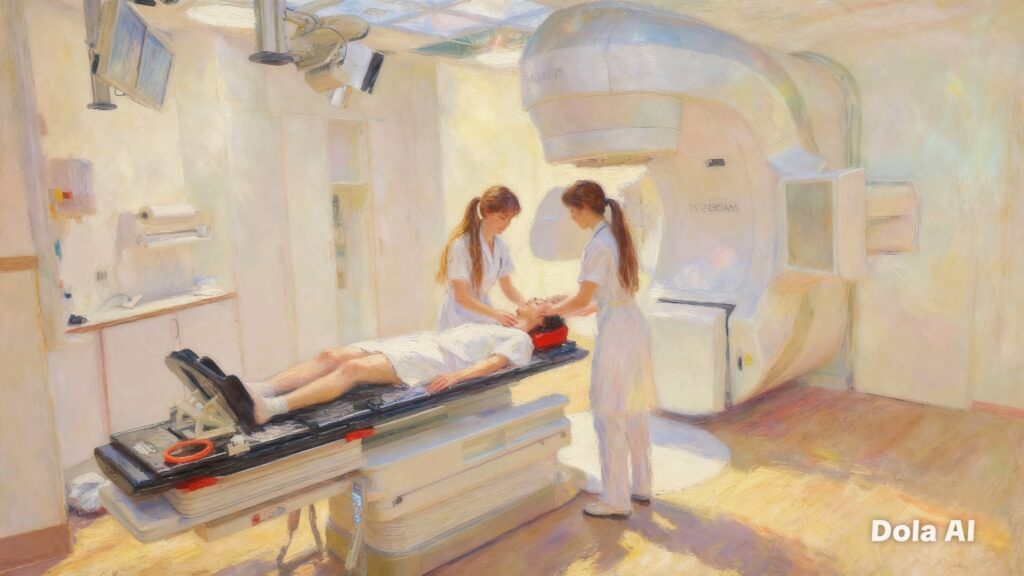
I am placed on a steel bed, with some ergonomic supports for my legs. With a number of laser beams, my three “tattoos” (small, and actually tattooed dots on my hips and tummy) are aligned with some positional markers. The bed is adjustable in many different degrees of freedom, to make it possible to reach the “perfect” position for the treatment. The nurses leave the room and the whole contraption with radiation head and X-ray machinery starts to rotate around my body, with short stops. making the final positional adjustments before the radiation is started. Finally it makes two full circles back and forth with a special, strange buzzing sound. I assume that that is the radiation phase.
And I don’t feel anything at all. The huge machine in the picture focuses the intense beam to precisely hit the small ‘dot’, smaller than a pea, that is the main character in this drama. The beam goes through a 360° rotation around me on the bed. It’s a very narrow but strong beam, invisible, but not at all harmless. And … I feel absolutely nothing. After approximately two minutes of buzzing and the continuous rotation of the radiation head, I’m ready to get up and go home again. No pain, no itch, no feeling of heat. But two minutes of high-energy photons (or electrons?) have made their impression on my non-wanted part of the body.
But as I lie there on the bed, I immediately start to think about the amazing computer system that handles this process from beginning to end. All the preparatory X-rays, alignments, calculations, and the careful dosages given by the machine are (of course) all handled by computers. And, I hasten to add, by the professional team they serve. It is even really mindboggling to think about the creation of the complete system of Human-Machine Interaction that allows for these (and many similar) tools to be used at hospitals all over the world.
But… it is also when I lie there, the machine buzzing and rotating that I get this very insisting thought that penetrates my thoughts:
AND THEN WE HAVE… COSMIC…
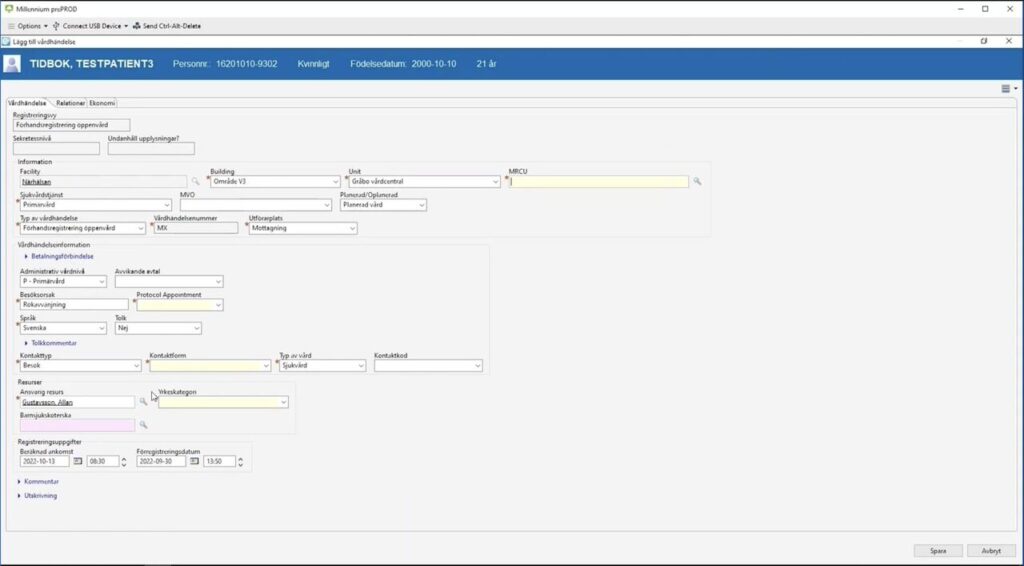
The contrast is on the brink to being hilarious, were it not that the topic is so serious and that people really have to work with COSMIC (I will not be so macabre, as to say… mi***nnium, but i guess you already thought about that?). Why, oh, WHY can we make such fantastic medical systems as the radiation treatment beamer, and then fail so miserably in making such an essential, “has-to-be” simple system for the storing of patient data?
WHY? OH, WHY?
POST SCRIPTUM: I have to give my full praise to the personnel on the clinics for radiation treatment and urology, who have been so wonderful and supportive in this difficult situation. Always happy and personal, providing a very large feeling of safety and comfort. Thank you, and I wish you could have a more friendly system than COSMIC at your workplace.