
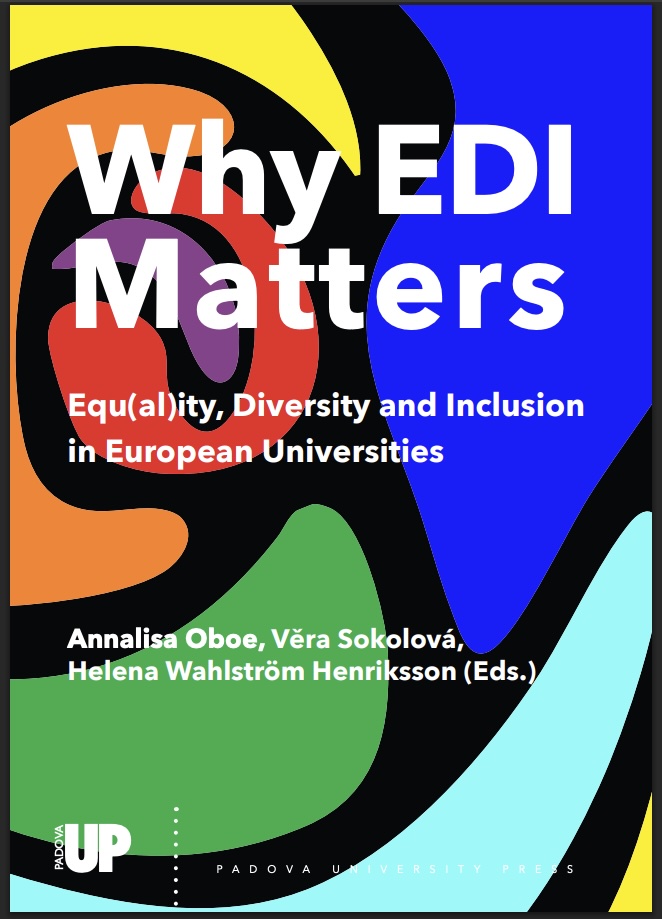
A new edited volume from Padova University Press, Why EDI Matters: Equ(al)ity, Diversity and Inclusion in European Universities (2025), brings together contributions from scholars and practitioners across a wide range of European university contexts. Edited by Annalisa Oboe, Věra Sokolová, and Helena Wahlström Henriksson, the book positions EDI not as a “nice-to-have” add-on, but as a core issue for universities’ legitimacy, resilience, and democratic role in society. You find the book here.
Importantly, the book is published under a Diamond Open Access model, with the explicit aim of making current debates and evidence on EDI widely accessible.
How the book is structured
The volume is organised into three sections: education and curriculum; discrimination and violence; and institutional change through policy and practice.
A chapter authored by Åsa Cajander
Åsa Cajander is one of the book’s chapter authors. Her chapter with Beni Suranto, Tony Clear, and Ramesh Lal is titled:
“Overlooked by Design: Challenges and Opportunities of Incorporating Human-Centred Perspectives and EDI in IT Development During the AI Boom.”
The chapter addresses a recurring tension in digital development: technological progress and rapid deployment often outpace inclusive, human-centred practices. It argues that integrating EDI into IT development becomes even more complex in the context of contemporary AI systems, where issues such as bias, opacity, and uneven impacts on marginalised groups are well-documented concerns. The chapter frames “integrating EDI into AI” as a deliberate, end-to-end commitment from data and design decisions to stakeholder engagement and governance rather than a late-stage “ethics checklist.”
Why this collection may be helpful to read
One of the strengths of Why EDI Matters is that it does not treat EDI as purely abstract. Across chapters, the emphasis is on the everyday realities of implementation: what universities actually do, what kinds of resistance or trade-offs arise, how policies land in practice, and what can be learned from concrete cases across national and institutional contexts.
For readers working in higher education leadership, teaching and learning, research management, digitalisation, or workplace environment roles, the book offers a multi-voiced snapshot of where EDI efforts currently stand, and why they remain central to the future of universities.