
Month: February 2026

AI i cancervården – men vill närstående verkligen prata med en chatbot?

Artificiell intelligens och AI-baserade chatbots lyfts ofta fram som en lösning på vårdens informationsbrist och resursutmaningar. Men hur upplevs dessa teknologier av dem som faktiskt befinner sig mitt i en cancersituation?

I en studie presenterad på Medical Informatics Europe Conference 2024 i Aten undersöker Awais Ahmad, Shweta Premanandan, Åsa Cajander, Ulrica Langegård, Ece Uereten och Ylva Tiblom Ehrsson hur närstående och vårdpersonal ser på användningen av AI-baserade chatbots inom vård av personer med huvud- och halscancer.

En tydlig tvekan

Studien bygger på sex fokusgrupper med 15 närstående och 13 vårdprofessionella från tre svenska universitetssjukhus. Resultaten visar en tydlig och utbredd tvekan inför att använda AI-chatbots i detta sammanhang.

Det som återkommer är:

  • En stark preferens för mänsklig kontakt i känsliga situationer
  • Misstro mot chatbotens medicinska information
  • Negativa tidigare erfarenheter av generiska och opersonliga svar
  • Oro för bristande anpassning till individens specifika situation

När det handlar om cancer, behandling och komplikationer vill man tala med en människa. Inte med ett system.

Teknikoptimism möter verklighet

AI-utvecklingen går snabbt och tekniken marknadsförs ofta som ett självklart stöd i vården. Men denna studie visar något viktigt: acceptans kan inte tas för given.

Endast en av de närstående uttryckte tydlig vilja att använda en chatbot, och det var en person med hög IT-kompetens och god förståelse för tekniken.

För de flesta handlade det istället om tillit. När vårdsituationen är komplex och emotionellt laddad räcker det inte med korrekt information. Relation, empati och möjlighet till dialog är centrala.

Vad betyder detta framåt?

Relationen mellan människa och AI är komplex, särskilt i vårdkontexter där sårbarhet, osäkerhet och existentiella frågor är närvarande.

Den här studien är en påminnelse om att vi måste undersöka intention att använda, tillit och upplevd meningsfullhet innan vi implementerar AI i praktiken.

AI kommer att spela en roll i framtidens vård. Men hur, när och på vilka villkor är fortfarande en öppen fråga.

Och det är just där forskningen behövs!

Referens

Ahmad, A., Premanandan, S., Cajander, Å., Langegård, U., Uereten, E., & Tiblom Ehrsson, Y. (2024). A qualitative study with informal caregivers and healthcare professionals for individuals with head and neck cancer on the usage of AI chatbots. In J. Mantas et al. (Eds.), Digital health and informatics innovations for sustainable health care systems (Proceedings of the 34th Medical Informatics Europe Conference, MIE 2024, Athens, Greece, 25–29 August 2024, pp. 751–755). IOS Press.

När cancer drabbar hela familjen

I en studie av Ulrica Langegård, Åsa Cajander, Awais Ahmad, Maria Carlsson, Emma Ohlsson Nevo, Birgitta Johansson och Ylva Tiblom Ehrsson undersöks vilka utmaningar och behov av stöd som finns hos närstående till personer med huvud och halscancer.

Den här forskningen ligger mig mycket nära hjärtat. Min man hade denna typ av cancer. Det var en jobbig period. Inte bara för honom, utan för oss. Vardagen fylldes av operationer, strålbehandling, oro, nya rutiner kring mat och mediciner och en ständig osäkerhet kring framtiden. Vi hade dessutom fyra barn hemma som var oroliga och behövde omsorg.

Studien visar hur närstående ofta känner sig dåligt förberedda på den roll de plötsligt får. Många saknar information om sjukdomen, behandlingen och hur de praktiskt ska hantera vården i hemmet. Samtidigt förändras relationen. En partner blir vårdare. Ett barn tar ansvar för sin förälder. Ansvar för hem och vardag flyttas över, ibland helt.

Osäkerheten är tung. Rädslan för komplikationer och återfall finns där hela tiden. Flera beskriver också en känsla av att stå utanför vården och inte fullt ut bli inkluderade.

Just därför är denna forskning viktig. Närstående är en avgörande del av cancervården, men deras behov av stöd hamnar ofta i skymundan. Genom att förstå deras erfarenheter kan vi utveckla bättre stöd, både praktiskt och emotionellt.

För mig är detta inte bara en akademisk fråga. Det handlar om hur vi tar hand om hela familjen när cancer drabbar. Nästa helg åker min man Vasaloppet och är fullt återställd, men det var verkligen en jobbig period.

Referens

Langegård, U., Cajander, Å., Ahmad, A., Carlsson, M., Ohlsson Nevo, E., Johansson, B., & Tiblom Ehrsson, Y. (2023). Understanding the challenges and need for support of informal caregivers to individuals with head and neck cancer: A basis for developing internet-based support. European Journal of Oncology Nursing, 64, 102347. https://www.ejoncologynursing.com/action/showPdf?pii=S1462-3889%2823%2900081-9

The Gender Gap in Electronic Health Record Experiences and Preferences

In a recent study, Anna Kharko, Josefin Hagström, Saija Simola, Åsa Cajander, Charlotte Blease, and Maria Hägglund analyse how gender is associated with patient experiences of electronic health records across Norway, Sweden, and Finland.

Drawing on responses from 27,038 patient portal users, the study shows that women use electronic health records more frequently than men and tend to rate more portal functions as useful.

While positive experiences were reported at similar levels, a higher proportion of women reported very negative experiences. Gender was associated with usefulness ratings for almost all functions, except contact with provider.

How might we interpret this pattern?

One possible explanation is that women generally have more frequent contact with healthcare services. Women also generally have more frequent and diverse interactions with healthcare services across the life course. This may increase both their need for, and engagement with, digital health services. My guess is that higher usage also increases the likelihood of encountering inconsistencies, errors, or confusing documentation, which may help explain why women report more negative experiences.

Another interpretation is that women may take on more caregiving responsibilities and administrative health-related tasks for family members. This could make functions such as error notification and certificate management more salient and valuable. My guess is that women’s broader coordination role in healthcare interactions may shape how they evaluate usefulness.

Overall, the findings suggest that gender is not merely a demographic variable but may reflect differences in health practices, expectations, and responsibilities. As patient portals become more personalized, considering these patterns may support more responsive and inclusive digital health design.

From a NordiCHI Workshop to a Published Paper

In 2024, we organized a workshop at NordiCHI on design methods in connected health. We had strong participation, and a wide range of connected health projects were presented and discussed. The workshop was structured to foster collaborative reflection on how different design approaches are used in real projects and what can be learned from them.

Following the workshop, we continued working with the material that emerged from the discussions and presentations. The submitted abstracts and workshop dialogues formed the basis for a joint paper, which has now been published in the Journal of Medical Internet Research.

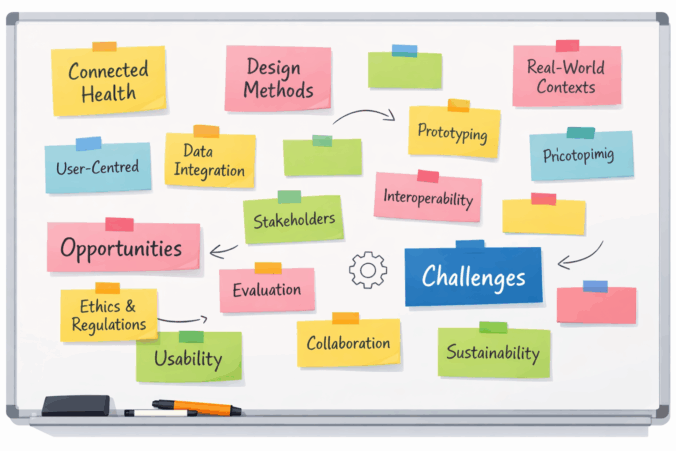
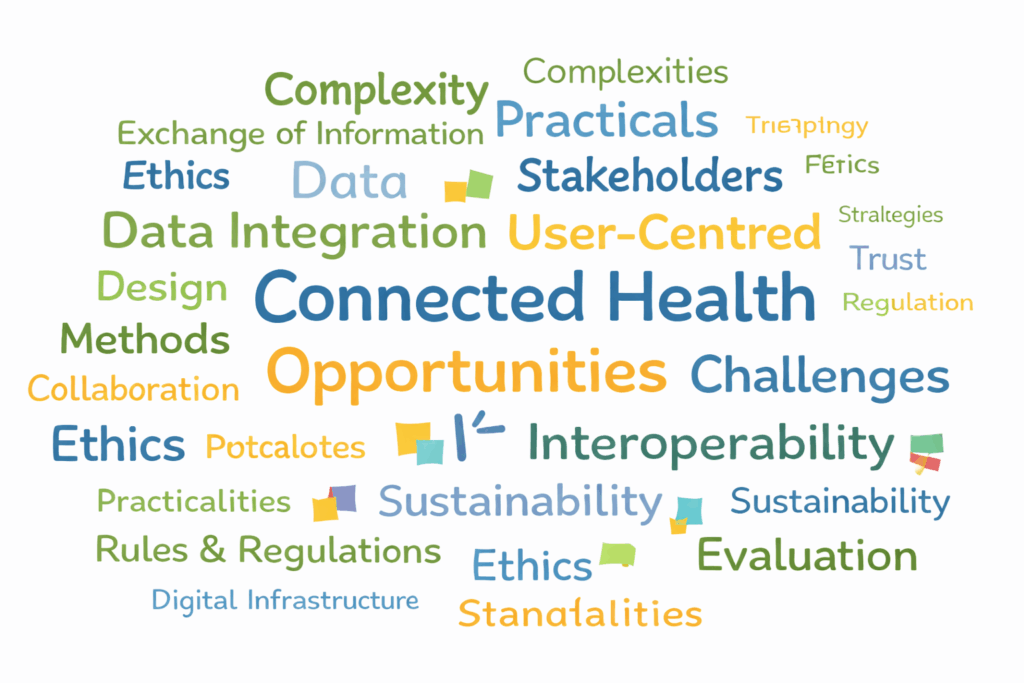
The paper synthesizes insights from six diverse connected health projects and highlights both opportunities and challenges experienced in designing connected health systems:

  • On the opportunity side, it identifies areas such as improving data integration and usability, enhancing collaboration across stakeholders, using iterative and user-centered design processes, addressing complexity in socio-technical systems, focusing on sustainability, and adopting digital infrastructures that support seamless communication.
  • At the same time, the paper also points out persistent challenges that practitioners face, including information exchange and interoperability, navigating ethical and legal requirements, understanding design and evaluation standards, ensuring trustworthiness and quality of data, and involving stakeholders effectively.

These insights come directly from workshop discussions and collective reflection across multiple projects. The paper brings together varied experiences to show what practitioners encounter when working with connected health systems in practice. This makes the findings relevant for researchers, designers, and policymakers interested in the practical side of digital health design.

The publication is timely because connected health technologies are becoming increasingly embedded in health care delivery and everyday care. Understanding both opportunities and barriers in their design — especially from real projects — helps ensure that these systems are usable, sustainable, and aligned with stakeholder needs.

We are pleased to see the workshop discussions evolve into a peer-reviewed publication, and we hope the paper is useful to others working on connected health design and implementation.

Blog post written by Shweta Premanandan

Ny publikation: Generativ AI i HCI. Ett verktyg, partner eller massbedragare?

Generativ AI i HCI – verktyg, partner eller massbedragare?

Generativ AI har på kort tid gått från teknikdemo till vardagsverktyg. Vi skriver med den. Vi designar med den. Vi undervisar med den. Vi forskar med den.

Men frågan är: Förstår vi egentligen vad vi har släppt in i våra digitala ekosystem?

I vår genomgång av forskningsfältet human–computer interaction (HCI) identifierade vi 37 vetenskapliga studier som behandlar generativ AI FULLTEXT01. Vi analyserade dem genom ett klassiskt HCI-begrepp: affordances och constraints – alltså vad tekniken möjliggör, och vad den samtidigt begränsar.

Resultatet? En betydligt mer komplex bild än den polariserade debatten ofta ger.

Möjligheter och risker – samtidigt

Generativ AI förbättrar algoritmer, stödjer kreativt samarbete och kan fungera som ett pedagogiskt stöd i utbildning. Den börjar röra sig från att vara ett verktyg till att bli en slags digital samarbetspartner.

Men parallellt återkommer tre stora problem i forskningen:

Sanning. AI hallucinerar och kan producera övertygande felaktigheter. I värsta fall desinformation och deepfakes.

Bias. Modellerna speglar snedvridningar i träningsdata och fungerar ofta som svarta lådor.

Ansvar. Maskiner kan inte hållas moraliskt eller juridiskt ansvariga – men deras output påverkar människor.

Dessutom förändras arbetsmarknaden. AI-kompetens blir en konkurrensfördel, samtidigt som arbetsroller omformas.

Det viktigaste fyndet: Allt beror på kontext

Vår analys visar något centralt:

Affordances och constraints är inte statiska. De överlappar. De växlar beroende på kontext.

AI i utbildning kan vara ett kraftfullt stöd, eller en källa till fusk och felaktigheter.
AI i arbetslivet kan vara ett kreativt komplement, eller en destabiliserande kraft.

Kort sagt: samma funktion kan vara en möjlighet i ett sammanhang och en risk i ett annat.

Det betyder att frågan inte är om generativ AI är bra eller dålig.

Frågan är hur vi designar, implementerar och reglerar den.


Läs mer i den här publikationen skriven av Niklas Humble och Åsa Cajander
Humble, N., & Cajander, Å. (2025, January). Rethinking Generative AI in Human-Computer Interaction: Review of Affordances, Constraints, and Implications. In Proceedings of the 2nd International Conference on Education Research. Academic Conferences and publishing limited.

https://www.diva-portal.org/smash/get/diva2:2010656/FULLTEXT01.pdf

Two days of intense work at Krusenberg Herrgård

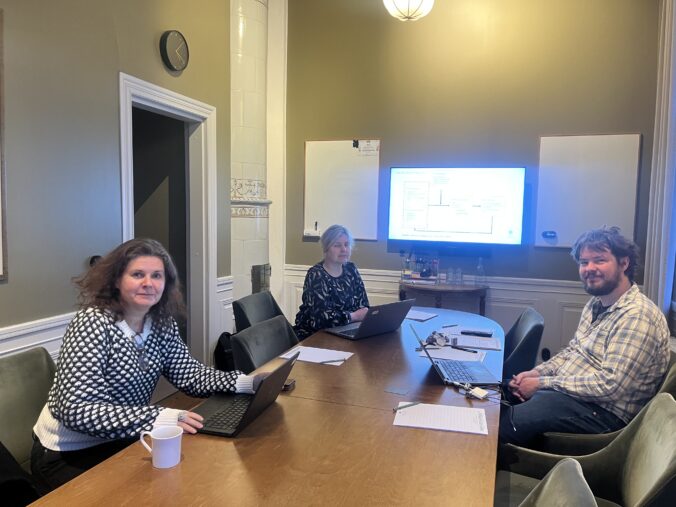
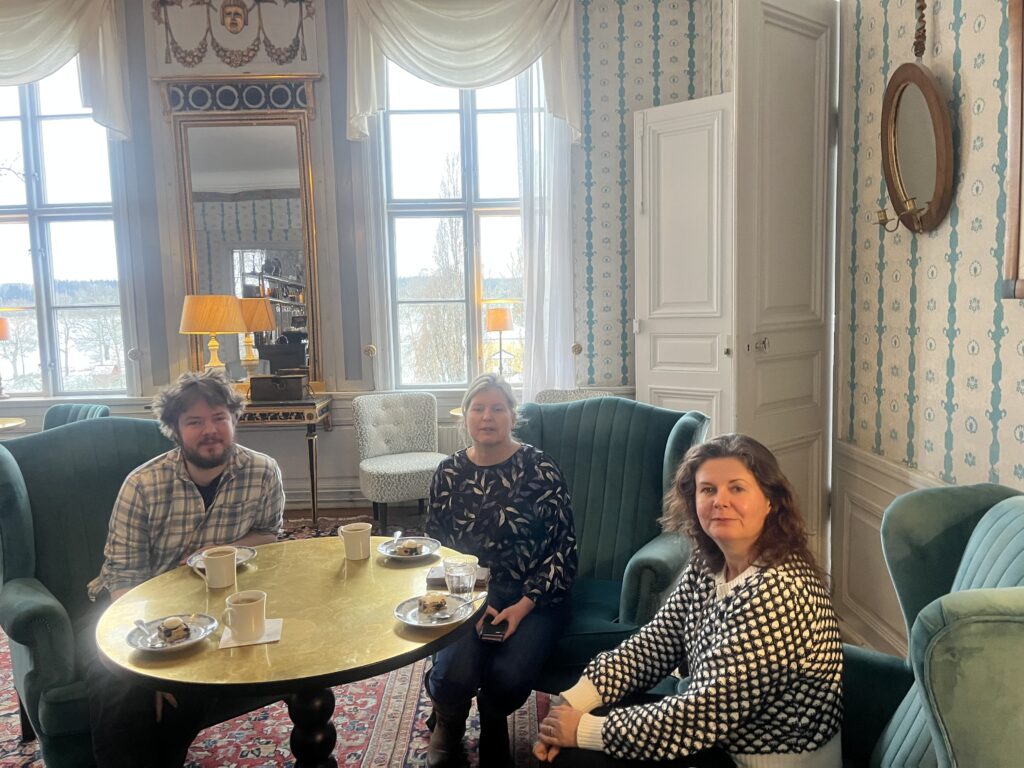
This week we spent two focused and inspiring days at Krusenberg Herrgård, just outside Uppsala, working together on the final steps of the AROA project, funded by AFA försälring. Krusenberg, with its calm surroundings and views over Lake Mälaren, offered an ideal setting for concentrated work, reflection, and discussion.

The environment clearly did its job. Several of us kept working well into the night, some until 01.00, others until 03.00, driven not by deadlines but by an overload of ideas, discussions, and theoretical connections that we simply did not want to interrupt.

The workshop focused on the last phase of AROA: synthesising empirical findings and theory into the project’s final theoretical framework. AROA explores how AI, automation, and robotics at work influence work engagement and socio-technical work dynamics. The project takes a human-centred and socio-technical perspective, aiming to develop a framework that can help identify opportunities for work engagement in AI-supported workplaces. Our discussions revolved around aligning concepts from work engagement research, sociotechnical systems theory, and empirical insights from multiple sectors into a coherent whole.

Participants in the workshop were Maria Normark, Jessica Lindblom, Andreas Bergqvist, and Åsa Cajander.

Alongside long work sessions, there was also time for shared fika, informal conversations, and moments of pause – important ingredients when ideas are being shaped and reshaped.

The Krusenberg days marked a milestone for AROA, and we now move forward with a clear sense that the pieces of the framework are coming together.

Stepping Forward: Reflections After My Research Stay at the HTO Group

This blog post is written by Jana-Sophie Effert, PhD candidate at TU Dortmund University.

A month back home in Germany: time enough to let impressions settle, but not quite enough for them to fade. After three months with Uppsala University’s HTO Research Group, I’m now back here on the blog to reflect on what those weeks have meant for me and my PhD journey. Since everyone at home keeps asking me about my experiences anyway, it feels like the perfect opportunity to bundle and share them here.

First things first: What I miss: The calmness of Swedish everyday life, being surrounded by nature, and that special kind of adventure that comes with living in another country. Further of course: colleagues, cinnamon buns and the HCI environment.

What I’m happy to have back: Of course, there’s comfort in returning home: subsidized student lunch options (no more microwavable meal-prep experiments!), being back in teaching, reconnecting with friends and family: simply enjoying the convenience of familiar surroundings. Yet even here, traces of Sweden remain; small habits and ideas keep resurfacing during daily work.

What I learned (even if it’s really hard to grasp)

1) Networking Across Fields

I was fortunate enough to join several events during my stay – from the DOME meeting on digital medical records and e-health services to national conferences on equal opportunities and social innovation in health. These experiences taught me how valuable spontaneous connections can be: finding overlaps between projects, brainstorming across disciplines, staying up-to-date with neighboring research fields. Networking turned out not just as professional exchange but as genuine inspiration.

2) Teaching From New Perspectives

One highlight was giving two guest lectures within HCI courses: From human-centered to intersectional design, another on work systems – socio-technical aspects of (in)accessible technologies. Sharing insights from rehabilitation sciences while learning how students approach inclusion through an HCI lens was a helpful angle and reminded me how much I like interacting with students‘ perspectives.

3) Feedback and Insights for my PhD Project

My research focuses on technologies supporting people with disabilities in work systems and their transitions into employment. During my stay, I not only had the chance to get feedback on my concrete approach and findings, but I also had the chance for job shadowing at Daglig Verksamhet in Sala. Observing inclusive practices firsthand offered new comparative insights for my project. These experiences helped refine questions about participation and technology use within real work environments.

4) Local Academic Routines

Academic life at Uppsala University left its mark: I participated in regular seminars, open group discussions, collaborative meetings. One thought that stuck with me is seeing this PhD journey again through its original purpose: becoming a “critical thinker,” not just an expert within a narrow niche.

Looking Ahead

Three months were certainly a good enough time to fill my head with thoughts and ideas. Now comes the part where these insights need sorting and weaving into ongoing projects here at TU Dortmund. Some collaborations initiated at UU are already continuing:

  • Participation & Accessibility: Together we’re developing a scoping review exploring how people with cognitive accessibility needs experience their involvement in Human-Centered Design or Co-Design activities.
  • Sustainability & Accessibility: We’re exchanging perspectives on sustainability and accessibility as value-based features of software development.

One thing is certain: I’m eager to return someday to this wonderful Swedish town, both professionally and personally. To anyone considering spending time with the HTO group: do it! Looking forward to being back, continuing working together and eventually share some joint research results on this blog 😊

A Research Visit That Sparked New Insights and Collaboration

Last December, Sita Vriend was given the opportunity to visit Uppsala University through support from the Equal Opportunities Fund.

My research focuses on human-centered uncertainty visualization, an area concerned with how uncertainty, which is all around us, is communicated through visual representations. Common examples include weather forecasts that show the probability of rain or storm predictions that visualize the possible paths a storm might take. The goal of my work is to better understand how users perceive such visualizations and how they can be designed more effectively. Along the way, I have become something of a data and statistics enthusiast. I enjoy the process of exploring data and creating clear, compelling figures.

Hence, I got asked to collaborate with Åsa Cajander and Jonathan Källbäcker to analyse data collected as part of TARA project (The Impact of Automation, Robotization and AI on the Work Environment of Airport Ground Staff). While I am experienced in data analysis and visualization, I was less familiar with the specific application context. This made the collaboration particularly valuable, as it provided opportunities to discuss unexpected patterns and oddities in the data. Jonathan was able to contextualize these findings by drawing on insights from interviews conducted during earlier research.

Our collaboration is ongoing. Additional data will be collected, and the analysis is still in progress, laying the groundwork for continued joint research in the future.

Sita Vriend, M.Sc.
Doctoral Researcher
Visualization Research Center (VISUS)
Weiskopf Group

Fem nya doktorandtjänster inom AI, utbildning och arbete

Nu har vi glädjen att kunna berätta att fem doktorandtjänster är utlysta inom HTO och UpCERG vid Uppsala universitet. Tjänsterna är en del av forskarskolan LärA AI och riktar sig till dig som vill bedriva forskning i skärningspunkten mellan AI, undervisning, läraryrket och arbetsmiljö.

Forskarutbildningen inom LärA AI erbjuder en stimulerande och sammanhållen miljö där doktorander från flera lärosäten möts kring gemensamma kurser, seminarier och tvärvetenskapliga utbyten. Här kombineras fördjupning i datavetenskapens didaktik och människa datorinteraktion med ett tydligt fokus på aktuella samhällsutmaningar kopplade till AI i utbildning.

Två av tjänsterna är placerade i datavetenskapens didaktik och handlar om kunskap, AI kompetens och organisatoriskt stöd samt om pedagogiska innovationer i AI utrustade klassrum. Tre tjänster ligger inom människa datorinteraktion och fokuserar på AI och etiska dilemman i lärares professionella praktik, AI:s påverkan på universitetslärares professionella omdöme samt AI, lärares arbete och arbetsmiljö i högre utbildning.

Doktoranderna kommer att ingå i ett starkt handledarteam med bred och lång erfarenhet av forskning om teknik, utbildning och arbete. Bland handledarna finns Åsa Cajander, Jessica Lindblom, Sofia Ouhbi, Mikael Laaksoharju, Roger McDermot, Calkin Suero Montero, Arnold Pears, Anneli Frelin och Aletta Nylén.

Utlysningarna är öppna nu och vi ser verkligen fram emot att välkomna nya doktorander till HTO, UpCERG och forskarskolan LärA AI. Fullständig information om respektive tjänst finns via Uppsala universitets rekryteringssystem:


https://uu.varbi.com/what:job/jobID:898728/
https://uu.varbi.com/what:job/jobID:898727/
https://uu.varbi.com/what:job/jobID:898725/
https://uu.varbi.com/what:job/jobID:898724/
https://uu.varbi.com/what:job/jobID:898722/