
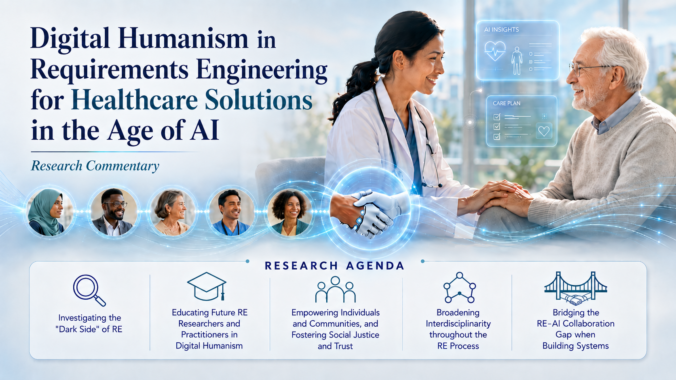
In healthcare, artificial intelligence (AI) may save clinicians time, automate routine activities, and support better decisions, but empathy, reassurance, trust, conversation, and human connection remain essential parts of care.
This is where digital humanism matters! Digital humanism argues that technology should be deliberately shaped around human values, rights, needs, and societal goals.
Shweta and I had the chance to explore this topic with other researchers in a research commentary on digital humanism in requirements engineering (RE) for healthcare solutions in the age of AI1. In the paper, we argue that RE can provide an important bridge between broad principles such as fairness, autonomy, privacy, explainability, and human oversight and the concrete requirements used to design healthcare systems. We also warn that RE itself can unintentionally contribute to harm when requirements reflect only the perspectives of easily accessible stakeholders while excluding patients, caregivers, marginalised communities, or other affected groups.
This perspective connects naturally with human-computer interaction (HCI). From an HCI perspective, human values must also be reflected in interaction. Human oversight is meaningful only if clinicians can understand, question, or override AI recommendations. Explainability matters only if explanations are understandable and useful. Patient autonomy depends on interfaces that support meaningful choice and accommodate different abilities, cultures, levels of digital literacy, and contexts of use.
RE can make human values explicit as requirements, while HCI can examine how those values are experienced and supported through interaction.
In the paper, we identified directions for future RE research, including: (i) examining the potential “dark side” of RE and how RE practices themselves may unintentionally reinforce exclusion or harm; (ii) educating future RE researchers and practitioners in digital humanism; (iii) empowering individuals and communities, and fostering social justice and trust; (iv) broadening interdisciplinarity throughout the RE process; and (v) bridging the RE-AI collaboration gap when building systems. These directions are equally relevant to HCI.
RE and HCI can help ensure that progress in AI-enabled healthcare serves people, rather than requiring people to adapt to technology.
1Ouhbi, S., Levy, M., Mondragon Campos, O.A., Lessard, L., Taveter, K., Fiorini, L., Premanandan, S., Fricker, S.A. and Amyot, D., 2026. Digital humanism in requirements engineering for healthcare solutions in the age of AI. Requirements Engineering, 31(2), p.11. DOI: https://doi.org/10.1007/s00766-026-00466-9