
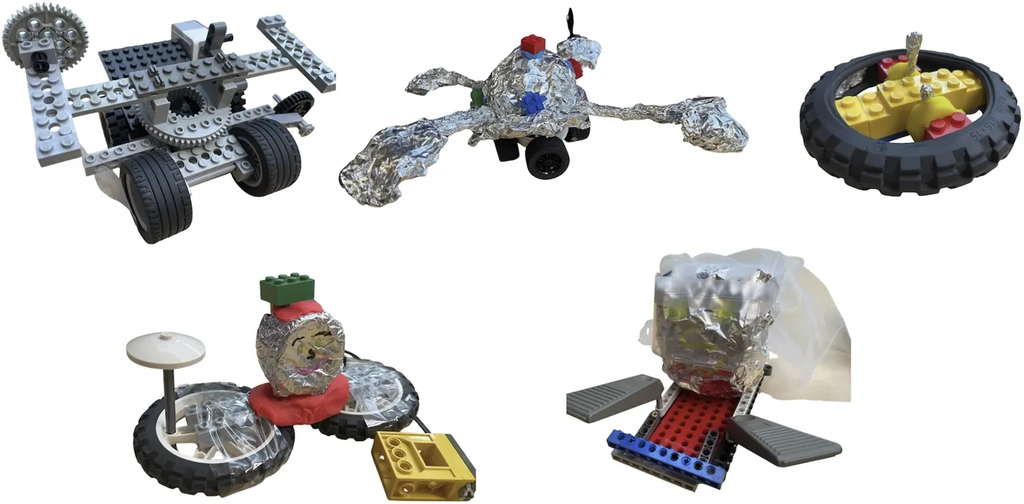
Human-drone interaction is an emerging field investigating ways to extend the conventionally passive role of drones with autonomous, socially interactive functionalities. Drones offer unique opportunities for applications, such as exercise support, due to their mobility and flexibility. While previous research has studied drones for, e.g., pacing, gait analysis, and accessibility in running contexts, we propose that an equally crucial part of such applications is the socially interactive role of the drone.
Our paper “Investigating social drones for recreational running through co-design” was recently published in Frontiers in Robotics and AI. In this paper, Stine Schmieg Johansen, Martin Bergström, Mohammad Obaid, and I, present a study in two phases. In the first phase, we conducted a preliminary study that informed the design of a co-design workshop through eight semi-structured interviews exploring drone support for runners. In the second phase, we designed and conducted a co-design workshop with five experienced recreational runners to reflect on the practical and ethical challenges of using drones and to envision ways in which drones could support and interact with runners in future scenarios. The results present five low-fidelity social drone prototypes (seen above), including participants’ reflections tied to each prototype. Furthermore, we present analytical themes that demonstrate the necessity of extending and re-framing approaches to designing social drones.
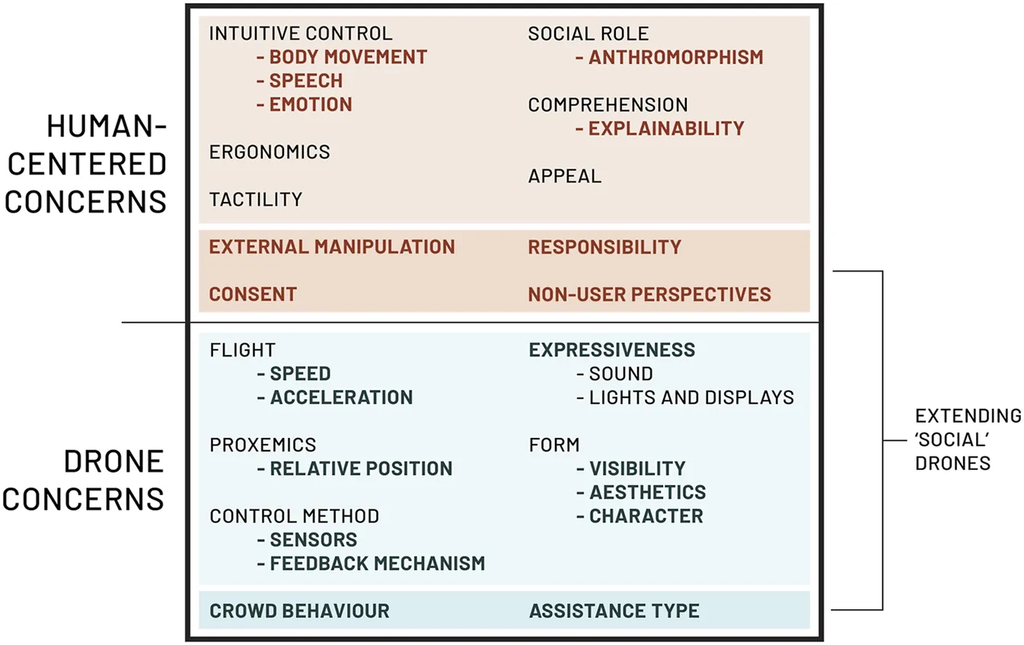
The results expanded the Design Space for Social Drones framework, previously developed by Bayatas et al. (2019). Bold = Extensions derived from the thematic analysis. Bottom of the two sections are non-user concerns.
Read the full paper here: https://doi.org/10.3389/frobt.2026.1897014
Citation: Thunberg S, Schmieg Johansen S, Bergström M and Obaid M (2026) Investigating social drones for recreational running through co-design. Front. Robot. AI 13:1897014. doi: 10.3389/frobt.2026.1897014