Last week, a few of us from the HTO research group attended the Nordic Conference on PhD Supervision. It was a very enjoyable conference, held on SLU’s beautiful campus here in Uppsala. The conference brought together supervisors, researchers, educational developers, and others interested in doctoral education to share experiences and discuss current developments and future directions in PhD supervision.
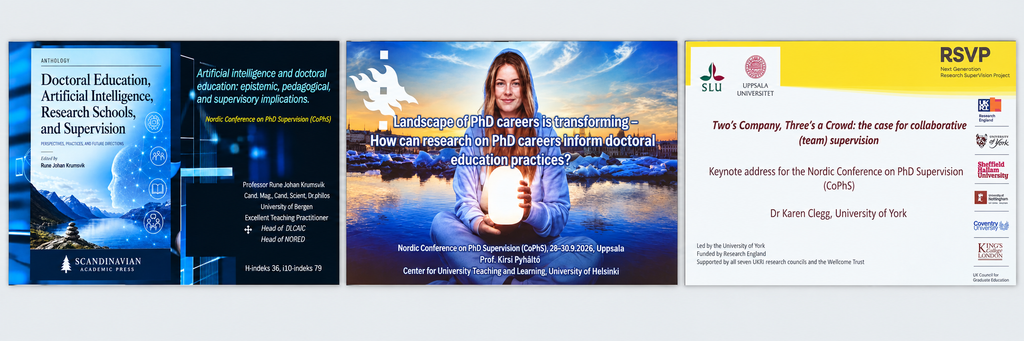
It was a well-organised conference and a great opportunity to spend a few days discussing PhD supervision with people from different universities and contexts. The keynote speakers captured three central challenges in PhD supervision today: Karen Clegg focused on the role of the supervisory team and the need to see supervision as a professional practice that develops over time. An important part of that is learning with and from colleagues, rather than treating supervision as something we develop individually and in isolation. Kirsi Pyhältö then turned to what happens after the PhD and discussed the changing career landscape for doctoral graduates, emphasising that supervisors need to actively prepare PhD students for what comes next, whether that is a career within academia or beyond it. And, of course, no conference today would be complete without a discussion of AI. At the CoPhS conference, Rune Johan Krumsvik took this on and explored what AI might mean for knowledge, learning and research, but also for the supervisory relationship itself
Taken together, the keynote talks raised fundamental questions that everyone involved in PhD education and supervision should be talking about: How do we support doctoral researchers during their studies? How can we prepare them for what comes after their education? And how can we, as supervisors, keep adapting and developing our supervisory practice as the context around us changes?
There were many interesting presentations during the conference, but one that particularly stayed with me was about building communities to enhance supervisory practice and collaborative problem-solving. Roisin Asfell and Julia Rayner from the University of York delivered this talk and proposed a model that uses small peer mentoring circles, where supervisors from different disciplines and with different levels of experience regularly meet to reflect on their supervisory practice. They described how the conversations were supported by coaching-informed approaches such as active listening and structured questioning, and rather than providing supervisors with ready-made answers, the aim of these circles was to create a space where supervisors could explore difficult situations together and learn from others’ experiences.
Feedback from the supervisors participating in these mentoring circles highlighted peer learning, a stronger sense of community, and increased confidence. I think this is a very important point. Teaching and supervising can easily become something we do quite independently. We work with our own students, encounter different types of situations and try to work out how best to respond. Yet many of the questions we face are not unique. Having a structured space to talk openly about those situations can help to normalise the challenges and bring in perspectives we might not otherwise have considered.
For me, the strongest message from the conference as a whole was that becoming a better supervisor is not an individual project but something we do together by making time for reflection, sharing experiences, and having ongoing conversations about supervision.
You could read more about the Nordic Conference on PhD Supervision, and also access the Book of abstracts here: Nordic Conference on PhD Supervision at SLU.